
When anxiety keeps winning after the meds stop working
If you are reading this while your chest feels tight and your thoughts will not slow down, that matters. Many people come to TMS treatment Florida after months of trying to outrun worry with medication and therapy. Sometimes the pills help for a while, then the edge comes back. Sometimes the side effects feel as exhausting as the anxiety itself. That frustration is real, and it can make every new option feel suspicious.
Why persistent worry can outlast SSRIs and talk therapy
Anxiety can behave like a smoke alarm that never resets. SSRIs, therapy, and coping tools can help, but they do not always quiet the same brain circuits for everyone. In some cases, you may still feel keyed up even when you are doing “all the right things.” That does not mean you failed. It means your treatment plan may need a different mechanism. For many patients, that is where transcranial magnetic stimulation therapy enters the conversation.
We hear this often from people who have tried more than one medication and still wake up with dread. One patient in South Florida described it like this: “My mind was tired, but my body never got the memo.” That is the kind of fatigue that pushes people to ask about TMS for anxiety and non-invasive brain stimulation. It also explains why some patients search for non-drug depression treatment at the same time, because anxiety and depression usually travel together. Here is the part most people miss: the problem is not only mood. It is often the circuit that keeps sounding the alarm.
What medication resistant anxiety often feels like in real life
Medication-resistant anxiety rarely looks dramatic from the outside. You may still go to work, answer texts, and pay bills. Inside, though, your mind may loop on worst-case scenarios, your shoulders may stay clenched, and sleep may feel shallow. Some days, you can taste the dry mouth from meds and still feel no relief. That mix can make people doubt themselves.
A woman from Broward told us she stopped scheduling social plans because she never knew when the panic would spike. She had already tried talk therapy and two medications. When she finally came in, she did not ask for magic. She asked for something that could make daily life feel less like a fight. That is a very reasonable request, and it is exactly why people explore TMS depression treatment Florida alongside anxiety care.
Where TMS for anxiety fits when daily coping stops holding
TMS for anxiety is not a sedative and not a personality change. It is a structured, office-based treatment that uses magnetic pulses to stimulate specific brain regions linked with mood and regulation. For some people, it becomes an option after failed medications, especially when the anxiety is paired with depression or OCD symptoms. For others, it is part of a broader plan that includes therapy and medication management. The point is not to replace everything. The point is to find what actually moves the needle.
At TMS care for anxiety in South Florida, patients often ask whether they need to “hit bottom” before considering this route. They do not. If your symptoms are persistent, disruptive, and resistant to standard care, that is enough reason to evaluate further. A thoughtful clinic will look at your history, current symptoms, and safety factors before recommending anything. That is how good care should work.
Why Florida patients start looking for non drug depression treatment and non-invasive brain stimulation at the same time
Florida patients often live with a strange mix of pressure and distance. Seasonal residents come and go. Schedules shift. Insurance plans change. That makes people look for treatments that fit real life, not just ideal conditions. Magnetic brain therapy and non-invasive brain stimulation sound technical, but the appeal is simple: no daily pill burden, no systemic sedation, and a treatment model that can be measured session by session.
TMS treatment Florida also appeals to people who have already felt let down by short appointments that only adjusted medications. If you are looking for a Florida mental health clinic, you may be comparing options from Miami to Orlando to Tampa while trying to keep your routine intact. That search is not selfish. It is practical. The right fit should respect your time, your symptoms, and your limits.
What transcranial magnetic stimulation therapy actually does to an overactive alarm system
The phrase sounds high-tech, but the idea is straightforward. How does TMS work? It uses magnetic pulses to gently influence brain activity in areas involved in mood and regulation. Think of it as helping a stuck circuit move with a little more flexibility. It is not surgery, and it does not involve anesthesia. That simplicity is part of why many people prefer it after exhausting other paths.
How does TMS work in plain language without the jargon
During transcranial magnetic stimulation therapy, a clinician places a coil against the scalp. The device sends brief magnetic pulses that pass through the skull and reach targeted brain tissue. Those pulses can change how active certain networks are, which is why TMS is often discussed as alternative depression treatment and non-drug depression treatment. It is also why people with anxiety, OCD, PTSD, or bipolar depression may ask whether their pattern of symptoms fits.
Research has continued to build support for this approach. The Clinical TMS Society consensus review and APA practice guidance both describe TMS as a legitimate option for appropriate patients. The 2018 Stanford study by Carpenter and colleagues also helped reinforce how useful TMS can be in depression care, especially for people with difficult-to-treat symptoms. That does not guarantee the same result for every patient. It does show why TMS has earned a serious place in modern behavioral health.
Why repetitive TMS and deep TMS therapy are different paths to the same goal
You will hear two terms often: repetitive TMS and deep TMS therapy. Repetitive TMS uses repeated magnetic pulses to target specific cortical areas. Deep TMS uses a different coil design that can reach broader or deeper networks. Both are forms of non-invasive brain stimulation, but they are not identical. A clinic should explain which method they use and why.
Here is a simple comparison:
FeatureRepetitive TMSDeep TMS therapyDeliveryRepeated magnetic pulsesBroader magnetic field patternUsual feelSurface tappingSimilar tapping, sometimes with different coil pressureTypical useMood and anxiety-related careMood, OCD, and other network-targeted careExperienceOffice-based, non-sedatingOffice-based, non-sedatingA strong clinic will not sell one as universally better. Instead, it will match the protocol to your diagnosis, history, and tolerance. That is the real standard.
What a session feels like from the chair to the clicking sound
Most people imagine something more intense than it actually is. You sit in a chair. The team positions the coil. You hear a clicking sound. You feel a tapping sensation on the scalp. That is usually the main sensory experience. Some people describe it as odd but manageable. Others barely mind it after the first few visits.
One client from West Palm Beach said the sound bothered her more than the sensation. After a few sessions, she stopped flinching and started bringing a book. That kind of adjustment matters. TMS side effects safety often comes down to preparation, pacing, and honest communication. If a clinic rushes that part, that is a red flag.
Which brain targets may matter when anxiety overlaps with depression OCD or PTSD
Anxiety rarely appears alone. It often shows up with depression, OCD, trauma symptoms, or bipolar depression. That is why brain targets matter. Some protocols focus on left or right prefrontal regions. Others use broader targeting for OCD or more complex presentations. If you are asking about TMS OCD therapy, TMS for PTSD Florida, or TMS for bipolar depression, the evaluation should reflect that overlap.
For depression-specific care, a clinician may talk about transcranial magnetic stimulation therapy for depression in Florida and relate it to score changes on tools like the PHQ-9 or MADRS. For OCD, they may discuss non-invasive brain stimulation for OCD in Florida. The exact target depends on symptoms, not on marketing language. That is a good thing.
The Florida clinic realities that shape your choice more than the brochure does
Florida is not one clinic market. It is many. A person searching for a TMS clinic Miami may face a different commute, different insurance network, and different follow-through burden than someone comparing TMS Fort Lauderdale or TMS Orlando. That matters more than glossy photos. Anxiety care works best when the treatment plan fits the geography of your life.
Why a TMS clinic Miami or TMS Fort Lauderdale may feel different from a TMS Orlando or TMS Tampa search
South Florida patients often balance traffic, work schedules, and family obligations in a way that makes consistency hard. A TMS clinic Miami may feel right if you are near Coral Gables, Aventura, or downtown. A TMS Fort Lauderdale search may suit people closer to Broward. In Central Florida, TMS Orlando or TMS Tampa may better match where you actually live and work. That sounds basic, but it determines whether you show up.
On the projects we have seen this year, the biggest mistake is choosing the fanciest office instead of the easiest one to reach. That leads to missed visits. It also leads to abandoned care. If you are dealing with anxiety, you need fewer friction points, not more. That is why local fit matters.
How proximity from Aventura Coral Gables Boca Raton Delray Beach and Winter Park can change follow-through
If your clinic is close, you are more likely to complete the full course. If it is an hour away, every appointment becomes a negotiation. People in Aventura and Coral Gables often think about parking, bridge traffic, and lunch-hour windows. Patients in Boca Raton or Delray Beach may prioritize a route that stays simple on busy days. In Winter Park, the question may be whether the clinic sits close enough to make weekly consistency realistic.
That is why searches like TMS near me Florida are not just convenience searches. They are adherence searches. They predict whether a treatment plan can survive real life. A clinic that understands this will talk about schedule, parking, and communication before it talks about branding. That is a good sign.
What to ask a Florida mental health clinic about outpatient rules AHCA oversight and care coordination
Florida clinics should be able to explain their outpatient setup clearly. They should also know the basic expectations around local licensing and the Florida Agency for Health Care Administration framework for outpatient care. You do not need a legal seminar. You do need confidence that the clinic takes compliance and coordination seriously. Ask how they communicate with your psychiatrist, therapist, or primary care clinician.
A thoughtful clinic will explain whether it coordinates with medication management and therapy. It should also tell you who reviews your progress and how often. If they cannot describe their process in plain English, keep looking. A respected Florida behavioral health provider makes the structure visible.
When TMS near me Florida matters more than luxury branding or glossy marketing
Some clinics market themselves like spas. That can be distracting. Luxury TMS center language may sound appealing, but it should never outrank clinical clarity. Ask about protocols, monitoring, and outcome tracking first. Then ask about aesthetics.
If you want a best TMS clinic Florida search to mean something, focus on the questions that reveal care quality. Who reviews you? How do they track symptoms? What happens if your response stalls? Do they offer TMS treatment near me in Broward County Florida or other location-based care that matches your routine? Those answers matter more than marble floors.
How to tell whether TMS is a serious option or just another promise
This part can feel uncomfortable. That is normal. After enough disappointment, even a solid option can sound like another sales pitch. The best way to protect yourself is to ask for specifics. Good clinics welcome that. Weak ones avoid it. 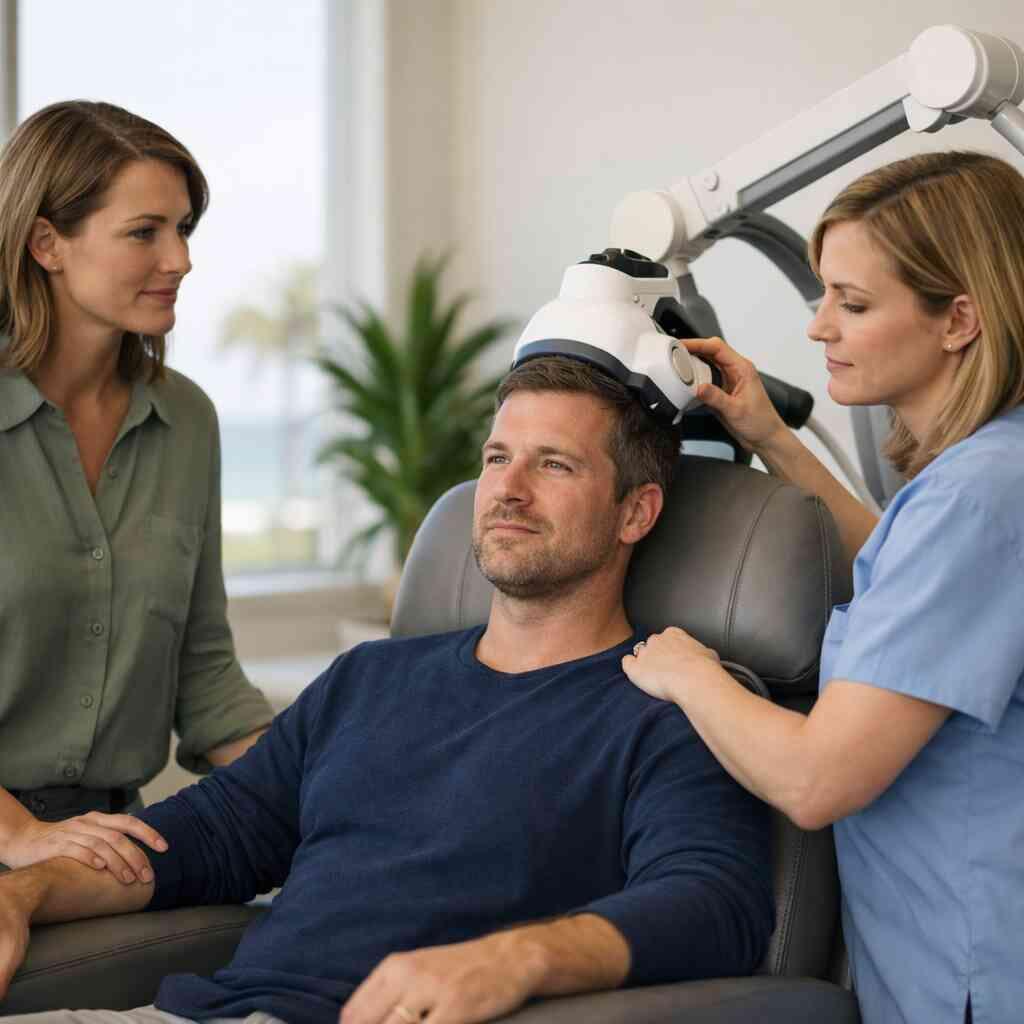
Who tends to get considered for TMS after failed medications
TMS is often considered for medication-resistant depression and related conditions when standard treatments have not helped enough. It may also be discussed after failed medications for anxiety, OCD, or bipolar depression. Some patients have side effects that make medication hard to tolerate. Others have partial benefit but still feel stuck. That is where a clinician may start thinking about TMS as part of the next plan.
For people seeking TMS after failed medications, evaluation is not a formality. It is the core of care. A clinic should review diagnoses, past trials, side effects, and current symptoms. If you are also dealing with substance use or trauma, the discussion should widen, not narrow.
What evaluation tools like PHQ-9 and MADRS can reveal before treatment starts
Objective tracking matters. The PHQ-9 and MADRS are common tools used to measure symptoms before and during treatment. They help clinicians see whether your scores are changing over time. They also give you something concrete to discuss when feelings alone are hard to sort out. That is useful because anxiety and depression can distort your sense of progress.
A clinic should not rely only on “How do you feel today?” That question has value, but it is incomplete. Numbers help anchor the conversation. That is especially important for TMS therapy success rate discussions, because no honest clinician should promise a universal result. The better question is whether the clinic measures change in a disciplined way.
How clinicians think about TMS side effects safety and who should pause for a closer review
TMS side effects safety usually centers on common issues like scalp discomfort, headache, or temporary fatigue. Serious risks are uncommon, but every patient needs a careful screen. That review matters even more if you have a seizure history, metal implants, or complex neurologic concerns. A clinic should ask detailed questions and never rush the clearance process.
If you want a patient-friendly summary, start with TMS side effects and safety guidance. The right clinic will also explain what symptoms to report during treatment. Safety is not a disclaimer. It is part of the plan.
What to ask about TMS insurance coverage Florida TMS cost Florida and does insurance cover TMS in Florida
Money questions are not rude. They are necessary. Ask whether they verify benefits, what diagnoses insurers usually require, and whether they can help you understand documentation. If you need a plain-language breakdown, look at TMS insurance coverage in Florida for 2026 and TMS cost in Florida and payment options. Those topics shape access as much as clinical fit.
In Florida, coverage can vary by plan, employer, and diagnosis. So the answer to does insurance cover TMS in Florida is usually, “It depends.” That is frustrating, but honest. A clinic should help you verify benefits before you commit. If they avoid that topic, be cautious.
What comes next after the chair time ends
People often think the hard part ends when the session does. It does not. Real care continues after the chair time, especially if anxiety has been layered over years of stress, grief, or substance use. That is where follow-up, therapy, and practical life changes matter most.
How maintenance therapy and long-term follow-up fit into real life
Some patients need TMS maintenance therapy to hold gains over time. Others do well with a full course and periodic check-ins. There is no single formula. The important piece is that the clinic plans for TMS long-term results instead of treating the last session like a finish line. Follow-up visits, symptom tracking, and medication coordination help reduce drift.
A good clinic will also tell you what to do if symptoms creep back. That conversation should happen before you are in crisis. Planning ahead makes relapse feel less mysterious. It also makes the next adjustment faster.
Where TMS fits alongside therapy OCD care bipolar depression support and addiction rehab Florida pathways
TMS can sit beside therapy, not replace it. That is especially true for OCD, bipolar depression, and dual diagnosis care. If you are in addiction rehab Florida or receiving dual diagnosis treatment Florida, your team should think about mood, cravings, sleep, and trauma together. There is also growing interest in TMS for substance use disorder and TMS addiction recovery, including research on cravings from centers such as the Medical University of South Carolina.
For depression-specific support, you may want to review TMS support for bipolar depression in Florida and dual diagnosis treatment support in Florida. If smoking or alcohol are part of the picture, ask about TMS for smoking cessation and alcohol addiction brain stimulation research. The evidence base is still evolving, but the conversation is increasingly serious. That matters.
Why TMS and EMDR combination is sometimes discussed for trauma-shaped anxiety
Trauma can teach the brain to stay on guard. That is one reason people ask about TMS and EMDR combination. EMDR may help process trauma memories, while TMS may help regulate the overactive alarm state that keeps returning. The combination is not automatic. It depends on the clinician’s judgment and your symptom pattern.
If PTSD is part of your history, ask whether the clinic collaborates with trauma therapists. If anxiety has a trauma core, that collaboration can be very useful. A clinic that understands both sides of the problem will speak about sequencing, pacing, and coordination. That is much more helpful than a one-size-fits-all promise.
How to choose the best TMS clinic Florida by focusing on fit follow-through and measurable care rather than hype
Start with the boring questions. Then trust the answers. Ask who interprets your symptoms, how they track outcomes, and how they handle missed visits. Ask whether they can discuss the plan with your existing therapist or psychiatrist. Ask what conditions they treat most often and how they adapt care for anxiety, OCD, or depression.
If you want a nearby practice that feels grounded and responsive, TMS Treatment Florida is worth reviewing with that lens. The best clinic is not the one that sounds the loudest. It is the one that can explain the plan, support your schedule, and respect your fatigue. You do not have to solve every part of this today. Start by comparing two Florida clinics, asking for benefit checks, and choosing the one that answers like a real partner.
Frequently Asked Questions
Does TMS work for anxiety in Florida?
TMS can help some people with anxiety, especially when it appears with depression or OCD. The best answer depends on your diagnosis, symptom pattern, and treatment history. A clinic should evaluate you carefully before recommending it. Ask how they track progress with tools like PHQ-9 or MADRS, and whether they treat anxiety directly or as part of a broader plan.
How many sessions does TMS usually take?
Most TMS plans involve multiple sessions across several weeks, but the exact schedule depends on the protocol and your clinic. Deep TMS therapy and repetitive TMS may differ in timing and targeting. Your team should explain the schedule before treatment starts. That way, you can plan work, rides, and follow-up without guessing.
What are the most common TMS side effects?
The most common side effects are mild scalp discomfort, headache, or temporary fatigue. Serious complications are uncommon, but safety screening still matters. Ask the clinic how they review seizure history, metal implants, and medication interactions. A careful evaluation is a good sign.
Does insurance cover TMS in Florida?
Sometimes, but not always. Coverage depends on your plan, diagnosis, and prior treatment history. Many insurers require documentation of medication trials and symptom severity. A clinic should help verify benefits before treatment starts, so you know the financial picture early.
Can TMS help with OCD, PTSD, or bipolar depression?
TMS may be considered for OCD and some forms of bipolar depression, and it is also discussed in PTSD-related care. The protocol matters a lot. Not every clinic treats every condition the same way. Ask whether they tailor the target and coil type to your symptoms.
What should I ask before choosing a TMS clinic near me in Florida?
Ask who supervises care, what outcomes they track, what insurance verification they provide, and how they coordinate with your therapist or psychiatrist. Also ask about location and parking, because follow-through matters. A clinic that answers clearly is usually a better fit than one that leans on marketing.


