When the tired pill routine stops touching teen depression
If your teen has already tried medication and still feels flat, angry, or stuck, that ache in your chest is real. You keep waiting for the medications to kick in, and nothing changes enough. Many Florida parents reach this point after months of watching grades slip, friendships thin out, and family dinners turn quiet. TMS treatment Florida is often searched at exactly this stage, when teen depression care needs another path.
Why Florida parents notice the slide from moody to medically concerning
Florida families often spot the shift during ordinary routines. A teen who once joked in the kitchen now barely answers. A soccer player starts skipping practice. A straight-A student misses assignments and shrugs. That can look like attitude, but it can also signal medication resistant depression. The hard part is that the change often happens slowly, then suddenly feels impossible to ignore.
We hear this from families across Broward, Palm Beach, and Orange counties. One parent in Coral Gables described a son who stopped eating breakfast, then stopped going to class early, then stopped texting friends back. The family thought it was stress. It turned into a fuller picture of depression, not defiance. That distinction matters, because the care plan changes when mood problems start shaping daily life.
What medication resistant depression can look like in school, home, and sports life
Medication resistant depression does not always announce itself in dramatic ways. More often, it shows up as half-finished homework, long absences, and a face that looks tired even after sleep. At home, you may hear more “I don’t care” than “I’m sad.” In sports, the teen may still show up, but the spark is gone. That loss of drive is easy to dismiss until it affects everything.
Here is the part most families miss. A teen can still be functioning and still be struggling deeply. That is why clinicians look beyond grades alone. They ask about energy, focus, appetite, motivation, and how hard simple tasks feel. Alternative depression treatment becomes a serious topic when the current plan no longer reaches the problem.
Why teen depression often shows up as irritability, sleep shifts, or shutdown instead of sadness
Teen depression rarely looks like the movies. It may look like snapping at everyone, sleeping until noon, or retreating behind a locked door. Some teens do not cry much at all. Instead, they get shorter, quieter, or more numb. That is why parents sometimes say, “I thought it was hormones.”
The sleep piece is often a giveaway. A teen may stay up late scrolling, then struggle to get out of bed. Or they may sleep more than usual and still feel exhausted. When mood and sleep start feeding each other, the whole house feels it. Teen depression care works best when those patterns are named early, without shame.
Why TMS feels different when nothing else has held
When medications have not helped enough, families often want to know what else exists that is not another pill. That question is fair. It is also one we hear constantly. Transcranial magnetic stimulation therapy offers a different model because it targets brain circuits linked to mood without sedation and without daily medication changes. For many families, that difference matters.
How transcranial magnetic stimulation therapy uses non invasive brain stimulation without sedation
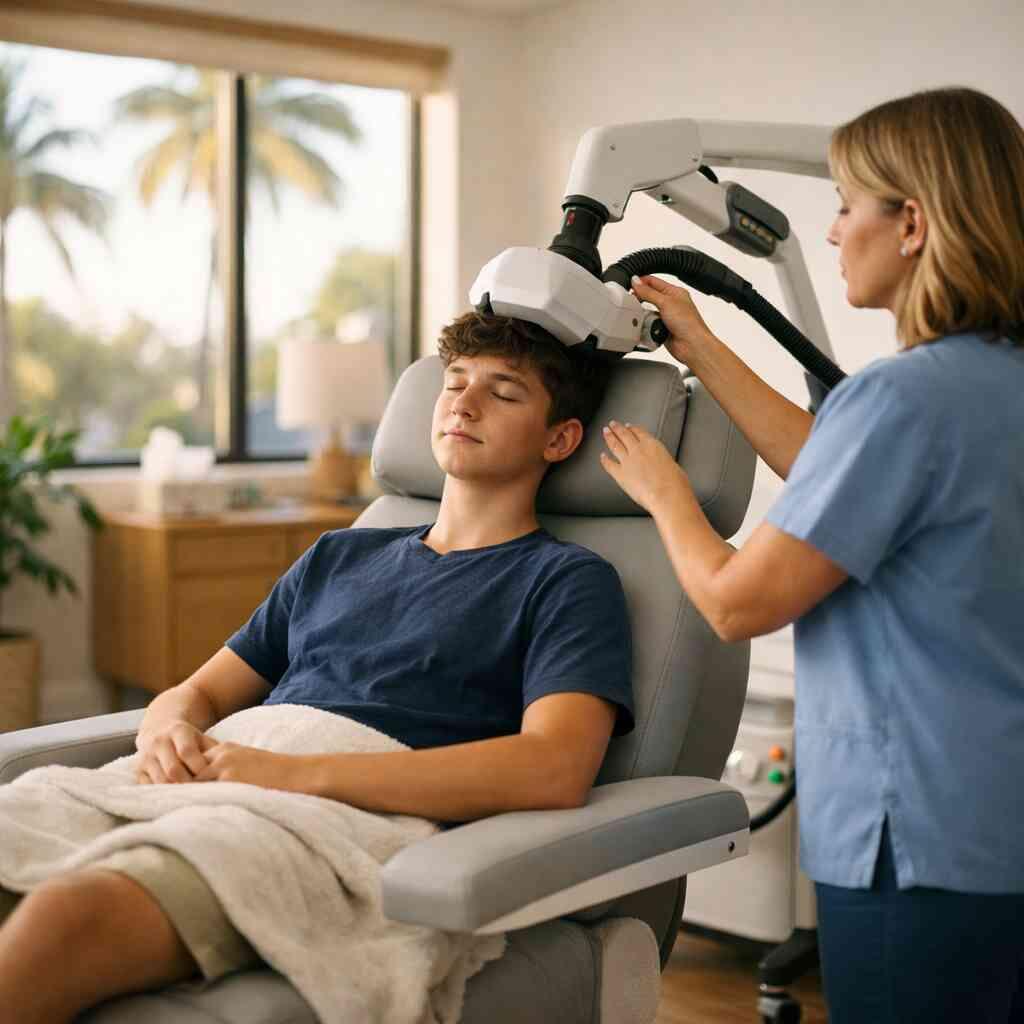
Transcranial magnetic stimulation therapy uses a magnetic field to stimulate a targeted area of the brain involved in mood regulation. It is a form of non-invasive brain stimulation, which means nothing is implanted and no anesthesia is used. The session usually happens while the person sits awake in a chair. They can talk, relax, and leave right after.
That simplicity is part of its appeal. Teens do not need to miss an entire day for recovery. Parents do not have to arrange a ride home from sedation. And for families already worn down by side effects, the idea of non-drug depression treatment can feel like a breath of fresh air. If you want a deeper science explanation, this non-invasive brain stimulation and how TMS works overview is a useful place to start.
What deep TMS therapy and repetitive TMS mean in plain language
You may hear two terms: deep TMS therapy and repetitive TMS. Repetitive TMS, or rTMS, uses repeated magnetic pulses over a treatment area. Deep TMS reaches a broader and deeper set of brain regions with a special coil design. Both belong to the family of magnetic brain therapy, and both fit under modern brain stimulation therapies for mood disorders.
Think of it like this: rTMS is a focused tap on a specific network. Deep TMS spreads that stimulation a bit farther. The right choice depends on symptoms, history, and the clinic’s protocol. Families often ask which is better, but the better question is which one fits the teen’s profile and diagnosis. For a plain-English comparison, see deep TMS and repetitive TMS explained in simple terms.
Why TMS after failed medications is getting attention in adolescent mental health support
TMS after failed medications has gained attention because many teens cannot tolerate dose changes, side effects, or partial response. The 2018 Stanford study by Carpenter and colleagues helped strengthen interest in TMS for depression, and the broader research base keeps growing. TMS is already used widely for adults, including under FDA-approved depression treatment pathways for certain devices such as NeuroStar and BrainsWay. For teens, clinicians still evaluate carefully, because adolescent use needs thoughtful screening and clear consent.
In 2026, families want fewer medication swings and more predictable days. That is where adolescent mental health support matters most. TMS is not magic. It is a structured, evidence-informed option that may fit when the usual route has not held. If you are comparing options after medications, this TMS after failed medications for medication resistant depression page can help frame the conversation.
What families should know before asking about TMS for teen depression
This part is genuinely confusing for most people. You may wonder who qualifies, what gets measured, and whether safety is truly settled. Those are the right questions. A good Florida mental health clinic should slow things down and explain the reasoning, not rush you toward a decision.
Which teens may be considered for TMS depression treatment Florida and who may need another path first
Not every teen is a fit for TMS. Clinics usually look for a clear depressive picture, enough maturity to sit through treatment, and a history that suggests standard care has not been enough. Some teens may be better served by medication changes, therapy, family work, or higher-intensity psychiatric care first. Others may need evaluation for bipolar symptoms, trauma, substance use, or sleep disorders before TMS enters the plan.
That careful sorting protects the teen. It also helps avoid false hope. TMS depression treatment Florida can be a promising option for some, but it should never replace a real diagnosis. If you are searching for the best TMS clinic Florida can offer, start by asking how they screen and who they do not treat.
How a Florida mental health clinic evaluates symptoms with tools like PHQ 9 and careful history
Good clinics do not guess. They use tools like the PHQ-9 and, when appropriate, the MADRS to track symptoms before and during care. They also take a careful history, including medication trials, sleep, school functioning, family patterns, trauma exposure, and any safety concerns. That is standard Florida behavioral health practice, and it helps shape a safer plan.
The Clinical TMS Society and APA-related guidance both emphasize proper evaluation and measurement-based care. That means the visit should feel thorough, not rushed. You may also want to ask about coordination with the teen’s therapist or psychiatrist. The more complete the picture, the better the treatment plan can fit the person, not just the diagnosis.
What to ask about TMS side effects safety, TMS maintenance therapy, and long term results without overpromising
Families deserve straight answers about side effects. Common questions include scalp discomfort, headache, fatigue, or temporary sensitivity at the treatment site. Serious side effects are uncommon, but safety screening still matters. If a clinic cannot explain TMS side effects safety in plain language, keep asking. You should also ask about TMS maintenance therapy and TMS long-term results. Some people improve and stay improved. Others need follow-up sessions or a maintenance plan. No honest clinic should promise a cure. Instead, ask how they track progress, what happens if symptoms return, and how they support next steps. For families who want a deeper safety review, this TMS side effects and safety for families resource is a practical starting point. How Florida clinics make care feel close to home
Families do not live in a brochure. They live in traffic, school pickup lines, work calls, and sports schedules. That is why location matters. A strong Florida mental health clinic makes access easier without making care feel rushed or clinical. For many parents, proximity is what turns consideration into action. 
Why TMS clinic Miami, TMS Fort Lauderdale, TMS West Palm Beach, TMS Orlando, and TMS Tampa searches often lead families to the same decision point
Searches like TMS clinic Miami, TMS Fort Lauderdale, TMS West Palm Beach, TMS Orlando, and TMS Tampa often point to the same bigger question: can your family realistically keep showing up? Teen care depends on consistency. If the clinic is too far, the plan falls apart fast. That is why many families compare a few locations before choosing.
In South Florida, access can feel easier for families in Aventura, Coral Gables, Boca Raton, and Delray Beach. In Central Florida, Winter Park families often weigh drive time against school and work schedules. If you want to compare locations directly, the Florida mental health clinic locations for TMS access page can help orient you. Local access is not a luxury. For many teens, it is the difference between staying engaged and dropping out of care.
How TMS near me Florida searches connect to school schedules, traffic, and family routines
A TMS near me Florida search is usually about more than convenience. It is about keeping the treatment plan realistic. A teen who has to miss half a day of class for every appointment may fall behind quickly. A parent who drives two hours each way may run out of steam. The right clinic understands that logistics shape outcomes.
What we see most often is that families want treatment to fit the week they already live in. Morning sessions can work better for some students. After-school appointments can help others. In Florida, traffic, storms, and seasonal resident patterns can complicate even simple plans. A clinic should help you build around those realities, not ignore them.
What insurance verification, TMS insurance coverage Florida, and TMS cost Florida questions usually need answered early
Money questions should come early, not late. Ask about verification before you schedule if you can. TMS insurance coverage Florida depends on the plan, diagnosis, medical necessity, and prior treatment history. Some insurers are familiar with TMS for depression; others need more documentation. That is normal.
You should also ask directly about TMS cost Florida if insurance does not cover everything. The clinic should explain estimates, not guess. Some families also search does insurance cover TMS in Florida because the answer varies so much. If you want a focused breakdown, review TMS insurance coverage and cost in Florida before scheduling.
Why location pages and local access matter for families from South Florida, Winter Park, Aventura, Coral Gables, Boca Raton, and Delray Beach
Local pages are not just SEO filler when they are done well. They help families see whether a clinic truly serves their area. That matters for parents in South Florida who juggle long commutes and school calendars. It also matters for people in Winter Park, where central access can be the deciding factor. Good location pages help you understand what care looks like before you call.
Families often mention that they want something like a luxury TMS center feel without losing warmth. What they really mean is privacy, order, and responsiveness. They also want confidence that the clinic knows Florida’s outpatient rules, including AHCA expectations for licensed care settings. If you are comparing providers, look for transparency, not polish alone. A clinic can look impressive and still miss the basics.
What a forward path looks like after the consultation
After the consultation, the goal is not to force one label onto every symptom. It is to build the right plan for the real person in front of you. Teen depression often overlaps with anxiety, OCD, trauma, or substance use. Good care should recognize that overlap quickly and respond with the right mix of tools.
How to weigh TMS for anxiety, TMS OCD therapy, and TMS for bipolar depression when symptoms overlap
A teen may show depression, but anxiety may be driving the worst days. Another may have intrusive thoughts and rituals that point toward TMS OCD therapy. Some teens show depression tied to mood swings, which raises the question of TMS for bipolar depression. These are not minor distinctions. They change the clinical plan.
That is why clinics often coordinate with psychiatrists and therapists before moving forward. TMS for anxiety may help when worry and tension keep the nervous system on edge, but it is only one part of a broader assessment. If you want a related overview, the transcranial magnetic stimulation therapy for adolescent depression support page can help you think through symptom fit.
When dual diagnosis treatment Florida or addiction rehab Florida may need to be part of the plan
Sometimes mood problems and substance use travel together. A teen may use alcohol or cannabis to dull panic, then feel worse the next day. In that case, dual diagnosis treatment Florida may be more appropriate than a single-track plan. Addiction rehab Florida programs can also help when use patterns are already disrupting school, family trust, or safety.
The SAMHSA TIP guidance for substance use disorders supports integrated, whole-person care. That matters here. If a teen is in withdrawal, intoxicated, or unstable in recovery, TMS should not be treated like a shortcut. It may still have a role later, but the immediate plan must respect the substance use piece first.
What to ask about TMS for PTSD Florida, TMS addiction recovery, and TMS for substance use disorder when cravings and mood problems share the stage
Families sometimes arrive asking about TMS for PTSD Florida because trauma and depression can look tangled. Others ask about TMS addiction recovery or TMS for substance use disorder when cravings and low mood keep colliding. Research on rTMS for cravings, including work from the Medical University of South Carolina and other centers, is growing. Still, this area remains more exploratory than standard depression care.
That does not mean it is irrelevant. It means you should ask smart questions. What symptom is driving the referral? Is the goal mood support, craving reduction, or both? How will progress be measured? Clinics that respect that nuance tend to make better long-term partners. If you want to read the clinic’s FAQs before calling, the FAQ page is a sensible place to start. And if you are ready to compare credentials, the team background page can help you see who is involved in care.
How to decide whether to contact the clinic, review insurance and costs, or read FAQ before scheduling
If the teen has already tried several medications, ask for a consultation. If insurance is your biggest concern, read the cost and coverage page first. If you still have basic questions about safety, scheduling, or what sessions feel like, start with the FAQ. That order saves energy. It also keeps the process calm.
TMS treatment Florida works best when the family has clear information and a realistic plan. You do not need to solve every question tonight. Start with one call, one insurance check, or one page review. Then choose the next move that feels manageable.
Frequently Asked Questions
Question: How does TMS treatment Florida support teen depression care when medication resistant depression has not improved symptoms?
Answer: TMS treatment Florida offers a compassionate next-step option for families exploring teen depression care after standard medications have not helped enough. Transcranial magnetic stimulation therapy uses non-invasive brain stimulation to target mood-related brain circuits without sedation or daily medication changes, which can be especially meaningful for teens who feel stuck, flat, or overwhelmed by side effects. It is often considered an alternative depression treatment or non-drug depression treatment when a teen has already tried multiple approaches and still needs more support. A thoughtful Florida mental health clinic should begin with careful evaluation, symptom tracking, and a full history so the plan fits the teen rather than forcing a one-size-fits-all solution.
Question: What should families know before asking about TMS for teen depression in the blog How TMS Treatment Florida Supports Teen Depression Care 2026?
Answer: Before asking about TMS for teen depression, families should know that a responsible clinic will screen carefully to see whether the teen is a good fit for TMS depression treatment Florida. That usually includes reviewing past medications, school functioning, sleep, mood patterns, and any concerns that may point to anxiety, trauma, bipolar symptoms, or substance use. The goal is not just to offer treatment, but to make sure the treatment is appropriate. Good adolescent mental health support also includes clear explanations of TMS side effects safety, what treatment visits feel like, and whether TMS maintenance therapy may be discussed later if symptoms improve. A trusted clinic should never promise results, but it should explain how does TMS work in plain language and help families make an informed decision with confidence.
Question: Can TMS near me Florida options help families in TMS clinic Miami, TMS Fort Lauderdale, TMS West Palm Beach, TMS Orlando, and TMS Tampa searches?
Answer: Yes, many families start with a TMS near me Florida search because location and consistency matter a lot in teen care. Whether a family is comparing TMS clinic Miami, TMS Fort Lauderdale, TMS West Palm Beach, TMS Orlando, or TMS Tampa options, the practical question is the same: can the teen realistically keep up with the appointment schedule? A clinic that understands Florida behavioral health needs should make access easier by offering clear scheduling, location details, and support that fits school and family routines. For families in TMS South Florida or other parts of the state, convenience is not just a preference; it can be the difference between starting care and dropping off.
Question: Does insurance cover TMS in Florida, and what should parents ask about TMS cost Florida before scheduling?
Answer: Does insurance cover TMS in Florida is one of the most common questions families ask, and the answer depends on the plan, diagnosis, prior treatment history, and medical necessity requirements. That is why TMS insurance coverage Florida should be checked early, before a parent feels locked into a decision. A good clinic will help explain authorization steps, possible documentation needs, and what out-of-pocket TMS cost Florida may look like if coverage is partial or unavailable. Families should also ask about TMS reviews Florida, the consultation process, and whether the clinic provides transparent estimates rather than vague guesses. Clear financial guidance helps reduce stress and lets parents focus on whether the treatment is the right fit for the teen.
Question: Are deep TMS therapy and repetitive TMS used for other conditions like TMS for anxiety, TMS OCD therapy, TMS for PTSD Florida, or TMS for bipolar depression?
Answer: Deep TMS therapy and repetitive TMS are both forms of magnetic brain therapy that may be discussed for a range of mood and behavioral health concerns, depending on the teen’s symptoms and diagnosis. Some families ask about TMS for anxiety when worry and tension are part of the bigger picture. Others may need to talk through TMS OCD therapy, TMS for PTSD Florida, or TMS for bipolar depression if the symptoms are more complex. In some situations, a clinic may also consider dual diagnosis treatment Florida or addiction rehab Florida support if substance use is interfering with recovery. A careful team should always assess the full clinical picture, coordinate with other providers when needed, and explain whether transcranial magnetic stimulation research supports the approach for that specific concern.
Question: Why might a family choose TMS Treatment Florida over another best TMS clinic Florida option for teen depression and young adults?
Answer: Families often look for a best TMS clinic Florida option that feels both professional and compassionate, especially when supporting a teen or young adult through depression. TMS Treatment Florida is focused on personalized treatment planning, family-centered mental health care, and careful evaluation so the care path fits the person’s needs. That matters when a teen has already tried several youth depression treatment options and still needs help. Parents also appreciate a clinic that can talk through TMS after failed medications, explain what to expect from transcranial magnetic stimulation therapy, and discuss follow-up care without overpromising. When the experience is supportive, transparent, and grounded in Florida behavioral health needs, families are more likely to feel steady enough to move forward with care.