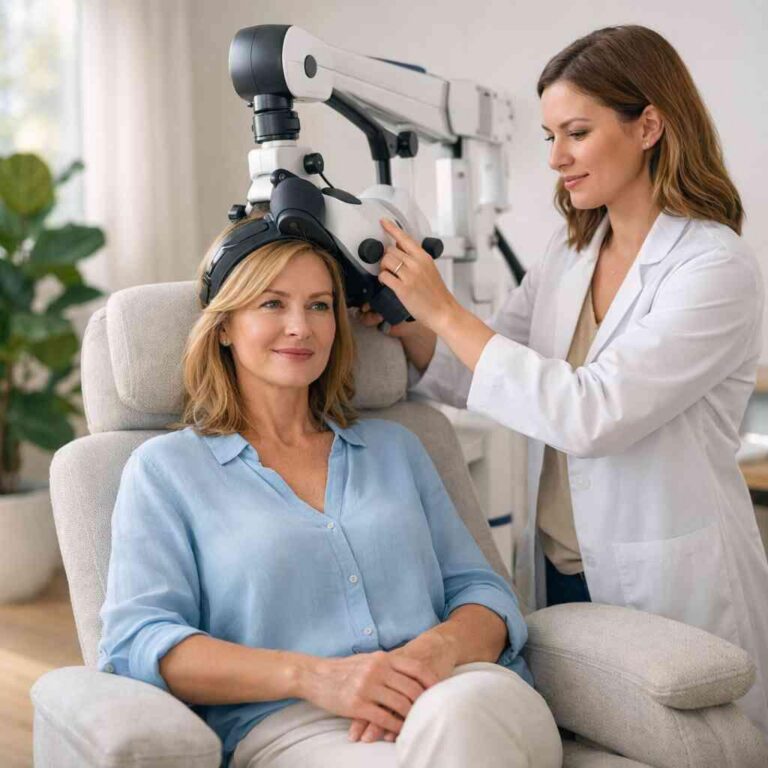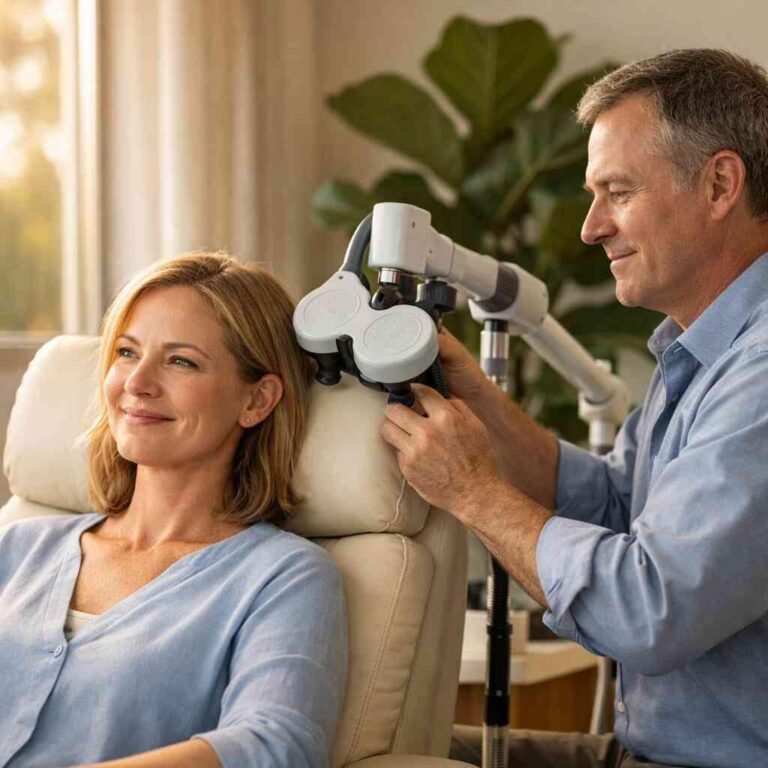
1) When the fog never lifts after treatment
The heaviest part is not always sadness. Sometimes it is the gray numbness that stays after you have already tried to fix it. If you are reading this because antidepressants helped a little, then stopped helping, that frustration makes sense. Many people feel worn down by the cycle of hope, side effects, and another disappointing refill. That is often when TMS treatment for depression and medication-resistant depression enters the conversation.
Why ongoing low mood after multiple antidepressants is the loudest warning sign
Ongoing low mood after several medications can signal medication-resistant depression. It does not mean you failed treatment. It means your brain may need a different kind of support. That is where transcranial magnetic stimulation therapy can become relevant as a non-invasive brain stimulation option. In clinical terms, providers often look at symptom patterns, medication history, and tools like the PHQ-9 or MADRS before suggesting next steps.
The question we hear most is simple: “Why do I still feel flat?” Sometimes the answer shows up in the morning mirror, the unopened email, or the canceled plan. The mood may not be dramatic. It may just never fully lift. That is why people searching for TMS depression treatment Florida often start after SSRIs, SNRIs, and therapy have not delivered enough relief.
In the clinics and behavioral health settings we have seen across South Florida, the pattern is often consistent. You keep functioning, but only barely. You sleep, but wake tired. You work, but feel detached. That kind of slow drain matters. It can justify a real conversation about TMS after failed medications and whether a Florida mental health clinic with TMS experience is the right place to ask questions.
How medication-resistant depression can look in daily life, from missed work to morning dread
Medication-resistant depression does not always look like crying all day. It can show up as missed shifts, late starts, and that heavy dread before your feet hit the floor. You may stare at the coffee maker for ten minutes. You may feel like every task has sand in it. Those details are not small. They are often the practical signs that treatment needs a new direction.
One client in the Boca Raton area described it this way: “I was still showing up, but I had no spark left.” That line stayed with us because it is so common. The person had tried therapy and several medications. The struggle was not willingness; it was the persistence of symptoms. In cases like that, a clinician may discuss alternative depression treatment options, including repetitive TMS or deep TMS therapy, depending on the presentation.
Here is the part most people miss. Depression can become so familiar that you stop naming it. You just call it tired. Or busy. Or stress. But if you have lived with this pattern for months, it may be time to ask how TMS works and whether a structured outpatient plan could help.
Why TMS depression treatment Florida often enters the conversation after SSRIs and talk therapy stall
TMS often enters the picture after traditional care stalls. That is not because it is a last resort in the dramatic sense. It is because it gives clinicians another tool when medication side effects, incomplete response, or relapse keep getting in the way. For many adults, that makes it an appealing non-drug depression treatment. It is also why people compare TMS therapy success rate claims carefully and ask about real-world outcomes instead of hype.
The strongest evidence base includes major studies and professional guidance. The 2018 Stanford study by Carpenter and colleagues helped reinforce TMS as a serious option for depression care. Professional organizations such as the American Psychiatric Association and the Clinical TMS Society have also published guidance that supports thoughtful use in appropriate patients. That is the kind of context worth hearing before you commit to another medication trial.
If you are looking in TMS South Florida, location convenience matters too. A clinic that is easy to reach from Coral Gables, Aventura, or Delray Beach can make follow-through easier. You may also see local searches for TMS clinic Miami, TMS Fort Lauderdale, or even TMS West Palm Beach. The right fit should feel clinically solid and logistically realistic. That balance matters more than flashy promises.
2) When anxiety keeps your body on guard even on calm Florida days
Anxiety can make a quiet room feel loud. Your chest tightens. Your mind runs ahead. Sleep gets thin, then thinner. On a bright Florida morning, your body can still feel like it is bracing for impact. If that sounds familiar, it may be worth asking whether TMS treatment for anxiety disorders in South Florida belongs in the discussion.
How constant chest tightness, racing thoughts, and sleep loss point toward TMS for anxiety
Persistent chest tightness, racing thoughts, and poor sleep can all suggest that the nervous system is stuck in overdrive. You might try breathing exercises, exercise, meditation, and structure. Those can help. But if the alarm stays on, they may not be enough by themselves. That is where TMS for anxiety may be discussed in a carefully selected outpatient plan.
The experience is often exhausting in a very specific way. You may feel wired and tired at once. You may check your phone constantly and still miss messages because your mind is spinning. This is not weakness. It is a body stuck in high alert. For some adults, that is what makes transcranial magnetic stimulation therapy feel worth exploring.
We hear this almost every week from people in Miami, Broward, and Palm Beach counties. They are not looking for magic. They are looking for steadier mornings and fewer physical surges. In some cases, that means asking about TMS for PTSD in Florida as well, especially when anxiety overlaps with trauma. A careful evaluation matters because not every anxiety picture is the same.
Why standard coping tools can fall short when the nervous system stays stuck in overdrive
Standard coping tools can be useful, but they have limits. If the nervous system keeps firing, worksheets and grounding exercises may feel like trying to quiet thunder with a hand fan. That is not a knock on therapy. It is a reminder that biology matters. Sometimes you need a different intervention, not just more effort.
That is where the conversation about magnetic brain therapy often becomes more nuanced. TMS is not sedating. It does not work like a pill you swallow. Instead, it uses targeted magnetic pulses to influence brain circuits linked to mood and anxiety symptoms. Research on transcranial magnetic stimulation continues to evolve, and outcomes are usually tracked with symptom scales, sleep changes, and functional improvement rather than dramatic overnight shifts.
Anxiety care optionMain strengthCommon limitationTalk therapyBuilds insight and coping skillsMay not quiet strong physical arousalMedicationCan reduce symptomsSide effects can limit useTMS therapyNon-invasive, outpatient, medication-free optionRequires a treatment seriesThat table is not a ranking. It is a reminder that different tools fit different problems. If you have tried coping skills and still feel trapped in constant tension, it may be time to ask about TMS for anxiety in a setting that understands Florida behavioral health needs.
Where outpatient transcranial magnetic stimulation therapy may fit for South Florida adults who need a non-drug option
Outpatient care matters because life keeps moving. You may still need to get to work, pick up kids, or drive across I-95 traffic after a session. That is why outpatient TMS therapy can feel more practical than higher-burden options. It is also why many people searching TMS near me Florida want a clinic that can work with real schedules and insurance questions.
For South Florida adults, access from places like Boca Raton, Aventura, Coral Gables, and Winter Park can shape adherence. A convenient location can remove a major barrier. If you are comparing clinics, it helps to ask about the assessment process, follow-up, and how they measure progress. Some clinics also reference TMS reviews Florida and outcome tracking, but you should still ask for specifics.
If you are wondering about the broader picture, how TMS works and transcranial magnetic stimulation research can help you understand the logic behind the treatment. A thoughtful consultation should cover benefits, limits, and whether anxiety is the main target or part of a larger pattern. That is how you avoid wasting time on a mismatch.
3) When OCD rituals start stealing your time and energy
OCD can look invisible from the outside. Inside, it can feel like your day belongs to the ritual. Check the lock. Check it again. Count. Recount. Clean until your hands feel raw. That is not just a habit anymore. If you have felt that shift, TMS therapy for obsessive-compulsive disorder in Florida may be worth discussing.
The red flags that repetitive checking, counting, or cleaning are no longer habits but life limits
The biggest red flag is time. If a ritual steals minutes from every hour, it steals energy too. You may miss appointments, leave late, or avoid places that trigger the cycle. You might know the behavior is excessive and still feel unable to stop. That gap between insight and control is one reason people explore TMS OCD therapy.
OCD often gets misunderstood as neatness or caution. Real OCD is more consuming. It can hijack driving, cooking, work routines, and even simple leaving-the-house moments. The questions that come up in clinic are often painfully practical. “Why does my mind keep demanding certainty?” or “Why can’t I trust what I already checked?” Those are the kinds of signs that a specialized evaluation is needed.
A clinical team may also discuss how symptoms affect exposure and response prevention work. If therapy has helped some, but not enough, the conversation may shift toward added options. That does not mean abandoning psychological care. It means combining tools intelligently.
How TMS OCD therapy may be discussed when exposure work and medication have not brought enough relief
For OCD, clinicians often think in layers. Exposure therapy builds tolerance. Medication can reduce intensity. TMS may be considered when those layers still do not free up enough time or function. That is especially true when symptoms remain rigid despite consistent effort. The goal is not perfection. The goal is more room in your day.
This is where TMS psychiatrist Florida searches often start. People want someone who understands both the science and the lived burden. The treatment discussion usually includes symptom history, prior medication trials, and whether the OCD pattern fits a protocol used for deep TMS therapy or another evidence-based approach. The FDA has cleared certain devices, including NeuroStar and BrainsWay, for specific indications, but a good clinician still matches the tool to the person.
If you want a grounded overview before talking with a provider, about transcranial magnetic stimulation therapy and non-invasive brain stimulation can help you understand the basics. The most useful question is not “Will this cure it?” It is “Could this give me back enough time and control to live better?” That question is honest. It is also the right one.
Why a TMS clinic Miami or TMS Fort Lauderdale search often starts after rituals begin affecting work, family, and driving
People usually search local terms after the rituals start colliding with daily life. Maybe you are late for work again. Maybe your family is tired of hearing the same reassurance question. Maybe driving has become a loop of lane checks and mirror checks. At that point, convenience matters, because care has to fit reality. That is why searches like TMS clinic Miami and TMS Fort Lauderdale are so common.
We have seen people delay care because they thought the commute would be too much. Then they learned that the right clinic could fit around work and family obligations. That detail can matter as much as the treatment itself. Florida traffic, school pickup, and seasonal residency patterns all affect follow-through. A clinic that understands those pressures earns trust faster.
If OCD has started shrinking your life, you may want to review local access points through TMS clinic locations in Miami-Dade County, Broward County, and Palm Beach County. The right next move is not to diagnose yourself. It is to get a proper assessment and ask how the clinic measures response, including functional changes, not just symptom reduction.
4) When cravings or substance use keep looping back no matter how hard you try
Cravings can feel unfair. You may want to stop. You may even know exactly why you should stop. Still, the loop returns. That pattern can be crushing, especially when depression or trauma sits underneath it. In those cases, people often ask about addiction treatment options and TMS care for cravings alongside standard support.
How TMS addiction recovery and TMS for substance use disorder are being explored for craving control
Research on TMS addiction recovery and TMS for substance use disorder is growing, especially around craving regulation. Studies from places like the Medical University of South Carolina have helped push the conversation forward. This is still an evolving field. It is not a substitute for evidence-based addiction care, but it is a promising area worth asking about, especially when relapse keeps happening after sincere effort. SAMHSA’s TIP guidance emphasizes that substance use treatment should address the whole person. That matters here. If cravings, stress, and mood symptoms are tangled together, a single strategy may not be enough. Some clinics discuss repetitive TMS as part of a broader plan, often alongside counseling, recovery support, and monitoring. 
People also ask about TMS for smoking cessation and alcohol addiction brain stimulation. Those are fair questions. Just remember that the evidence is still developing, and protocols vary. A good clinic will be honest about that. It should never oversell the treatment or pretend results are guaranteed.
Why dual diagnosis treatment Florida matters when depression, anxiety, or trauma sit beside alcohol or drug use
Dual diagnosis matters because substance use rarely travels alone. Depression, anxiety, PTSD, sleep loss, and shame often show up alongside it. If you treat only one layer, the others can keep the cycle alive. That is why dual diagnosis treatment Florida should be part of the conversation when you are evaluating recovery options.
This is also where TMS for bipolar depression may come up, though it needs careful psychiatric screening. The wrong fit can muddy symptoms or miss a mood disorder entirely. That is why a thoughtful evaluation matters more than a quick marketing pitch. Florida clinics should be mindful of licensure, outpatient standards, and AHCA expectations for safe care environments.
One man in the Delray Beach area told us he kept relapsing after every stressful family event. What finally got his attention was not the substance itself. It was how fast his mood collapsed before each return to use. That pattern suggested he needed more than detox planning. It suggested a treatment plan that recognized depression, trauma, and craving together.
What to ask about TMS for smoking cessation and alcohol addiction brain stimulation before assuming another rehab stay is the only path
Before you assume another rehab stay is the only answer, ask pointed questions. Ask whether the clinic has experience with TMS addiction recovery. Ask what symptoms they target. Ask how they coordinate with counseling or recovery programs. And ask how they decide if TMS is appropriate for your specific history.
Here is a simple checklist:
- Does the clinic screen for depression, anxiety, and trauma?
- Do they coordinate with addiction therapy or psychiatry?
- Do they explain what evidence supports the protocol?
- Do they review insurance and follow-up options clearly?
- Do they discuss safety and side effects in plain language?
That kind of clarity matters. If you are comparing addiction rehab Florida options, the smartest choice is usually the one that treats the whole pattern, not just the behavior. You can also ask about TMS treatment in Palm Beach County if proximity matters. Treatment works best when you can actually keep showing up.
5) When side effects cost more than the prescription itself
Sometimes the problem is not that medication does nothing. Sometimes it does too much of the wrong thing. You may feel foggy, emotionally blunted, restless, or physically off. That tradeoff can start to feel too expensive in another way. If that is where you are, TMS insurance coverage and cost in Florida is a practical place to start asking questions.
How brain fog, weight changes, sexual side effects, and emotional flattening can point toward non-invasive brain stimulation
Medication side effects can be a dealbreaker. Brain fog makes work harder. Weight changes affect energy and self-image. Sexual side effects can strain relationships. Emotional flattening can make life feel smaller than it should. Those are real costs, even when the prescription is technically helping.
That is why some people consider non-drug depression treatment options like TMS. It is not about rejecting medicine. It is about choosing a path that fits your body and your life. In careful studies, outcomes are usually measured with scales like the MADRS or PHQ-9, not vague feelings alone. That kind of tracking helps clinicians judge whether treatment is truly helping.
The safety conversation matters too. Ask about TMS side effects safety honestly. Common effects can include scalp discomfort or headache early on, though many people tolerate treatment well. You want straight answers, not marketing language. A good clinic will explain what to expect and what to do if discomfort shows up.
Why people in TMS South Florida often ask about TMS insurance coverage Florida before they ask about TMS cost Florida
Cost matters, but coverage often matters first. Many people in TMS South Florida ask “does insurance cover TMS in Florida?” before they ask the price. That order makes sense. Coverage can shape everything from eligibility to out-of-pocket planning. Florida’s insurance landscape can be uneven, so verification matters.
Here is the practical reality. Some plans cover TMS for depression when criteria are met. Others require prior authorization or documented failed medications. A clinic that understands TMS insurance coverage Florida can help you avoid surprise bills and wasted time. If you are comparing options, ask for verification before you schedule.
The article-so-far context also points to location convenience. People in Orlando or Tampa may search TMS Orlando or TMS Tampa, while seasonal residents often search TMS near me Florida after arriving back in state. If you want a clinic that can help with access and documentation, how to find a TMS clinic near me in Florida is a useful local resource.
What makes TMS side effects safety and maintenance therapy important if you want a non-drug depression treatment that can fit real life
The best treatment plan is the one you can sustain. That is why TMS maintenance therapy matters for some people after an initial course. Not everyone needs it. But some people benefit from a maintenance schedule if symptoms begin to creep back. The point is long-term stability, not endless treatment.
In the cases we have seen this year, the people who do best usually ask better questions upfront. They want to know session length, schedule fit, and how progress gets measured over time. They also want to understand TMS long-term results without anyone pretending certainty exists where it does not. That is healthy. It shows good judgment.
If you are comparing providers, ask whether they track outcomes with PHQ-9, MADRS, or functional check-ins. Ask whether they offer a clear consultation with a TMS psychiatrist Florida patients can trust. And if you want to review team standards before making a call, how to find the best TMS clinic in Florida should make credentials and clinical background clear enough to help you decide. You do not have to sort all of this out tonight. Start with one call, one insurance question, and one honest conversation.
Frequently Asked Questions
What are the top signs you may benefit from TMS treatment in South Florida?
The most common signs include depression that has not improved after several medications, anxiety that stays physically intense, OCD rituals that eat up time, cravings that keep returning, and medication side effects that feel harder to live with than the symptoms. Many people also seek help after therapy or standard care has stalled. A proper evaluation should confirm whether TMS is a good fit for your diagnosis and treatment history.
How does TMS work for depression and anxiety?
TMS uses targeted magnetic pulses to stimulate brain networks involved in mood regulation. It is an outpatient, non-invasive treatment. For depression, clinics often track symptoms with tools like the PHQ-9 or MADRS. For anxiety, the goal is usually to reduce persistent overactivation and improve daily function. A clinician should explain whether you are a candidate for repetitive TMS or another protocol.
Is TMS safe, and what side effects should I expect?
TMS is generally well tolerated, but side effects can happen. The most common are scalp discomfort, headache, or temporary sensitivity during sessions. Serious risks are uncommon, but a provider should review your medical history carefully. Ask directly about TMS side effects safety, how they handle discomfort, and whether your medications affect candidacy.
Does insurance cover TMS in Florida?
Sometimes, yes. Coverage often depends on your diagnosis, failed medication history, prior authorization, and the specific health plan. That is why many people ask about TMS insurance coverage Florida before discussing cost. A clinic that verifies benefits can save you time and help you understand expected out-of-pocket expenses before you commit.
How long does a TMS treatment series take?
A typical course usually involves repeated outpatient sessions over several weeks, though exact timing depends on the protocol and diagnosis. Some people also discuss maintenance therapy later. Your provider should outline the schedule, follow-up plan, and how they define improvement. The goal is not just symptom relief, but a plan that fits real life.
Where can I find a TMS clinic near me in Florida?
If you are in Miami-Dade, Broward, or Palm Beach County, look for a clinic with local access, clear insurance support, and psychiatric oversight. Many people search from Aventura, Coral Gables, Boca Raton, Delray Beach, or Winter Park because convenience affects follow-through. Start with a consultation request and ask how the clinic matches treatment to your diagnosis, goals, and schedule.