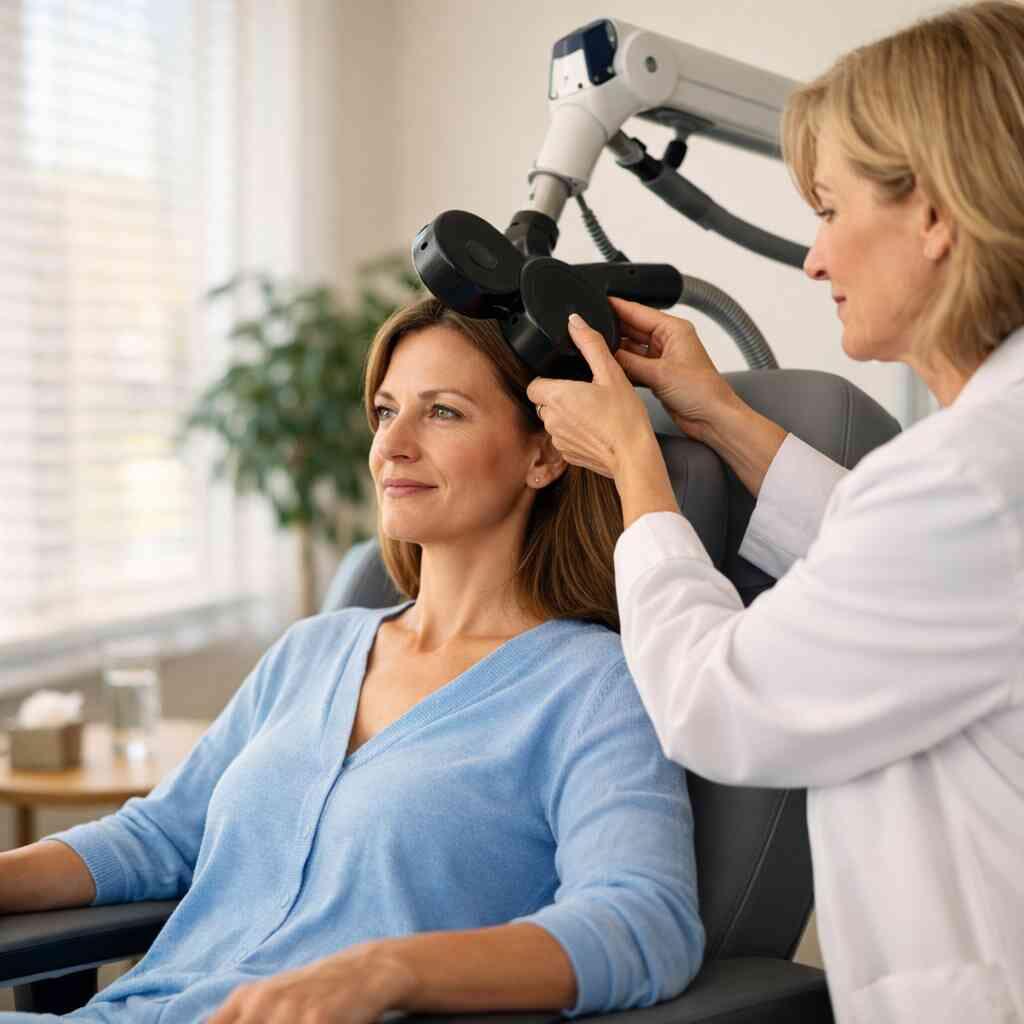
The first question we hear is blunt: “Will TMS feel worse than the depression?” That fear is real. If you have already fought through medication changes, dry mouth, grogginess, and stalled hope, the idea of magnetic brain therapy can sound intimidating. The good news is that transcranial magnetic stimulation therapy is designed to be non-invasive brain stimulation, not a sedating procedure.
One client near Coral Gables said the waiting room felt calmer than expected, but his hands still shook before the first pulse. He had spent months reading about side effects of TMS therapy and rare TMS risks. After the first session, he mostly noticed tapping on the scalp and a brief headache that faded with water and rest. That reaction is common. The bigger issue is often anxiety about the unknown, not the treatment itself.
When TMS side effects feel scarier than the symptoms you are trying to treat
What most people notice in the room during a first TMS session
A first session usually feels strange, not painful. You sit in a chair, stay awake, and hear a steady clicking sound. Some people feel tapping on the scalp, a light thump, or mild muscle movement near the forehead. Most clinics walk you through what to expect during TMS therapy before anything starts.
The room itself matters. A quiet office in a Florida mental health clinic can feel very different from a busy medical suite in Miami-Dade or Broward. That calm setup helps because your nervous system is already on guard. Here is the part most people miss: fear can make the first ten minutes feel longer than the actual procedure.
Which side effects are common and usually mild with transcranial magnetic stimulation therapy
Common TMS side effects safety discussions usually include headache, scalp tenderness, and temporary fatigue. Some people also feel lightheaded or notice mild jaw tension. These reactions are usually short-lived and often improve as your body adjusts. They do not mean the treatment is failing.
With repetitive TMS and deep TMS therapy, the sensation can differ a little because the coil placement and magnetic field reach vary. Still, the common pattern stays the same: brief discomfort, then adaptation. If you have sensitive skin, a history of headaches, or you react strongly to noise, tell the clinic before treatment begins. A good team can adjust the approach and make the chair time easier.
When a headache, scalp tenderness, or fatigue should prompt a call to the clinic
A mild headache after treatment is common. So is a tired, drained feeling that reminds you of post-flu days. But you should call the clinic if symptoms feel intense, last unusually long, or get worse after each visit. That matters more than any online list of common TMS side effects.
Also call if you notice new confusion, fainting, or anything that feels out of pattern for you. Serious complications are uncommon, but clinics should take every concern seriously. One patient from Delray Beach told us she almost canceled after a sore scalp on day two. Instead, the clinic reviewed her coil positioning, slowed the pace, and the soreness eased. Sometimes safety is less about alarm and more about communication.
What actually happens to the brain during non-invasive brain stimulation
How repetitive TMS and deep TMS therapy differ in plain English
People often ask, how does TMS work? In simple terms, a coil sends focused magnetic pulses into targeted brain areas involved in mood and self-control. Those pulses influence neural activity without surgery or anesthesia. That is why many people call it non-drug depression treatment or alternative depression treatment.
Deep TMS therapy reaches slightly deeper brain networks, while standard repetitive TMS usually targets a more superficial area with precise mapping. Both belong to the larger family of non-invasive brain stimulation. The difference is less about drama and more about delivery. The right choice depends on your diagnosis, anatomy, symptoms, and the clinic’s protocol.
Why FDA approved depression treatment can still feel unfamiliar at first
FDA-approved depression treatment sounds reassuring, but unfamiliar can still feel unsettling. TMS is not magic, and it is not a quick fix. It is a structured, evidence-based treatment that requires repeated sessions and monitoring. For many people with medication-resistant depression, that regular rhythm feels new after months of trial-and-error pills.
Research has supported TMS for depression for years, including work by Carpenter and colleagues and broader transcranial magnetic stimulation research. Clinical TMS Society consensus reviews and APA guidance both emphasize careful selection and follow-up. If you want a plain-language overview, the treatment page can help frame what happens in the chair without overstating promises.
What research on TMS depression treatment Florida says about monitoring progress with PHQ-9 and MADRS
Good clinics do not guess about progress. They track mood changes with tools like the PHQ-9 and MADRS. Those measures help compare your starting point to later visits. That is how TMS depression treatment Florida stays grounded in data, not wishful thinking.
A person in West Palm Beach once told us she could not tell if she was “better” because she still felt tired. But her PHQ-9 scores were dropping, and her sleep had improved. That kind of change matters. It also explains why TMS long-term results are usually discussed through follow-up scores, function, and maintenance therapy, not dramatic claims.
Who is a good fit when medication-resistant depression keeps winning
Signs that TMS after failed medications may be worth a closer look
If you have tried more than one antidepressant and still feel stuck, TMS after failed medications may be worth discussing. This is especially true when side effects became the main story. Some people notice emotional flattening. Others get nausea, insomnia, weight changes, or sexual side effects that make treatment feel unlivable.
The phrase medication-resistant depression can sound discouraging, but it often just means the brain has not responded well to standard drug treatment. That is where TMS treatment Florida can feel different. It is a non-drug depression treatment that may fit people who want a more focused, clinic-based option. If you are comparing options, the depression treatment page can be a useful starting point.
Why TMS for anxiety, TMS OCD therapy, and TMS for bipolar depression need careful screening
TMS for anxiety, TMS OCD therapy, and TMS for bipolar depression can all be appropriate in certain cases. Still, these uses require careful screening and clear expectations. Anxiety symptoms may overlap with depression, and OCD treatment often uses different targeting strategies. Bipolar depression adds another layer, because mood-switching risk must be considered.
That is why a TMS psychiatrist Florida search should focus on assessment quality, not just convenience. The best clinics ask about panic symptoms, compulsions, sleep patterns, mania history, and current medications. If you want a deeper look at symptom-specific care, review anxiety treatment options and OCD treatment options. For bipolar questions, a careful bipolar treatment review matters even more.
How TMS for teen depression and TMS for young adults changes the conversation about safety and expectations
Younger patients deserve extra care. TMS for teen depression and TMS for young adults can raise questions about development, school schedules, family consent, and symptom tracking. Safety discussions should be calm, specific, and age-appropriate. No one should be sold certainty they do not have.
The conversation also changes because younger people may carry more shame about needing help. A college student from Orlando once said the hardest part was explaining treatment to a roommate. She needed a plan that fit classes, not a speech about neuroscience. That is where clear scheduling and honest expectation-setting matter most.
The safety checklist Florida clinics should follow before anyone sits in the chair
What a careful evaluation should cover before TMS treatment Florida starts
Before TMS treatment Florida starts, a careful evaluation should cover diagnosis, medication history, psychiatric history, and risk factors. It should also include sleep, substance use, and any past head injury. Good clinics ask about prior responses to treatment, not just current symptoms. That is essential for candidacy for TMS treatment.
If you are looking for TMS near me Florida, you should expect a structured intake, not a rushed sales call. A thoughtful evaluation helps separate depression, anxiety, PTSD, and bipolar features. It also helps determine whether you need TMS for PTSD Florida, TMS addiction recovery support, or another referral. If you want to see how clinics frame preparation, the preparation guide is worth a look.
How Florida mental health clinic standards and AHCA rules shape outpatient care
Florida mental health clinic standards and AHCA rules shape how outpatient care should be organized. That means documentation, informed consent, emergency response planning, and privacy protocols matter. A responsible clinic does not treat TMS like a casual wellness service. It treats it like a medical procedure with guardrails. 
In South Florida, seasonal resident patterns can also affect scheduling and continuity. That matters if you split time between Boca Raton and another city, or if you need follow-up during travel months. Clinics serving TMS South Florida patients should have systems for continuity, not just fast intake. If you want location details, the clinic locations page helps you compare access across regions.
Why seizure history, metal implants, and substance use disorder screening matter for TMS addiction recovery and dual diagnosis treatment Florida
This is the safety part people should never skip. TMS requires screening for seizure history, metal implants, and certain implanted devices. These concerns do not automatically rule out care, but they must be reviewed carefully. Safety beats speed every time.
The screening also matters for TMS addiction recovery and dual diagnosis treatment Florida. Substance use can change seizure threshold, medication plans, and symptom patterns. SAMHSA guidance for substance use disorders encourages integrated care, and research on rTMS for cravings, including work associated with the Medical University of South Carolina, continues to expand. If you want a focused overview, see the substance use disorder page.
What to do next if you are comparing TMS clinic Miami, TMS Fort Lauderdale, TMS Orlando, or TMS Tampa
How to judge TMS insurance coverage Florida without getting lost in fine print
Insurance can feel like the hardest part. TMS insurance coverage Florida varies by plan, diagnosis, prior authorization rules, and documentation requirements. So does the answer to “does insurance cover TMS in Florida.” Some plans cover TMS for depression more readily than for off-label concerns. Others require proof of failed medications and therapy.
The safest move is to ask for a benefits check before committing. A clinic should explain the likely paperwork, not hide it. If you are sorting out coverage, the insurance and costs guide can help you ask better questions. That matters if you live near Aventura, Coral Gables, or Winter Park and need a practical plan.
When TMS cost Florida matters and when the real issue is fit, follow-up, and maintenance therapy
Yes, TMS cost Florida matters. But cost should be weighed against fit, consistency, and follow-up. A cheaper option that cannot track progress or support TMS maintenance therapy may cost more in the long run. The real question is often not price alone, but value.
If you are comparing clinics in Miami, Fort Lauderdale, or Tampa, ask about follow-up schedules, progress measures, and support after the acute series. Ask how they handle TMS therapy success rate conversations without making promises they cannot prove. For a practical comparison of payment structures, the cost and payment page can clarify what to expect.
What to compareWhy it mattersScreening processAffects safety and fitProgress trackingHelps measure response with PHQ-9 or MADRSInsurance verificationReduces surprise denialsMaintenance optionsSupports TMS long-term resultsReferral coordinationHelps with Florida behavioral health needs### How to choose a best TMS clinic Florida option that can also coordinate TMS and EMDR combination or referral support for Florida behavioral health
The best TMS clinic Florida option should feel organized, calm, and clinically serious. Look for a team that explains how TMS works, what side effects are expected, and what happens if your symptoms change. A strong clinic can also coordinate with therapy providers, psychiatry, or EMDR when appropriate. That matters for people with trauma, OCD, or addiction histories.
If a clinic also supports referral pathways for Florida behavioral health, that is a good sign. It shows they think beyond one tool. One patient from Broward told us the best part was not the machine. It was the way the clinic coordinated care when sleep and anxiety needed separate attention. If you are still sorting through TMS reviews Florida, use them as one data point, not the whole decision.
Frequently Asked Questions
Does TMS hurt?
Most people describe TMS as tapping, not pain. The first few sessions can feel odd, and some people notice scalp tenderness or a mild headache. Those effects usually stay manageable. If discomfort increases or feels sharp, tell the clinic right away.
What are the most common TMS side effects?
The most common side effects are headache, scalp discomfort, facial muscle twitching, and temporary fatigue. Noise sensitivity can also happen. These usually improve as sessions continue. A good clinic will check in often and adjust if needed.
Is TMS safe for medication-resistant depression?
For many people, yes, when screened carefully and monitored properly. TMS is widely used for medication-resistant depression and has substantial research support. Safety depends on evaluation, coil placement, seizure risk review, and follow-up. That is why clinic quality matters so much.
Can TMS help with anxiety or OCD?
It can help some people, but those uses need careful assessment. TMS for anxiety and TMS OCD therapy often require different treatment planning than depression care. Not every symptom pattern fits every protocol. A qualified clinic should explain that clearly.
Does insurance cover TMS in Florida?
Sometimes, but not always in the same way across plans. TMS insurance coverage Florida depends on diagnosis, policy rules, and prior authorization. Some plans support TMS for depression more easily than for other uses. The clinic should verify benefits before treatment begins.
How do I know if a Florida TMS clinic is safe?
Look for thorough screening, clear consent, progress tracking, and a real plan for emergencies. Ask about seizure history review, implant screening, and how they document outcomes. If they cannot explain those basics, keep looking. Safety should feel structured, not rushed.
What should I do today if I think TMS might be right for me?
Write down your medication history, current symptoms, and any side effects you cannot tolerate. Then call one clinic and ask for a benefits check and evaluation. If you are comparing Miami, Fort Lauderdale, Orlando, or Tampa options, pick the one that answers clearly and calmly. You do not have to solve everything today, but you can make one informed call.


