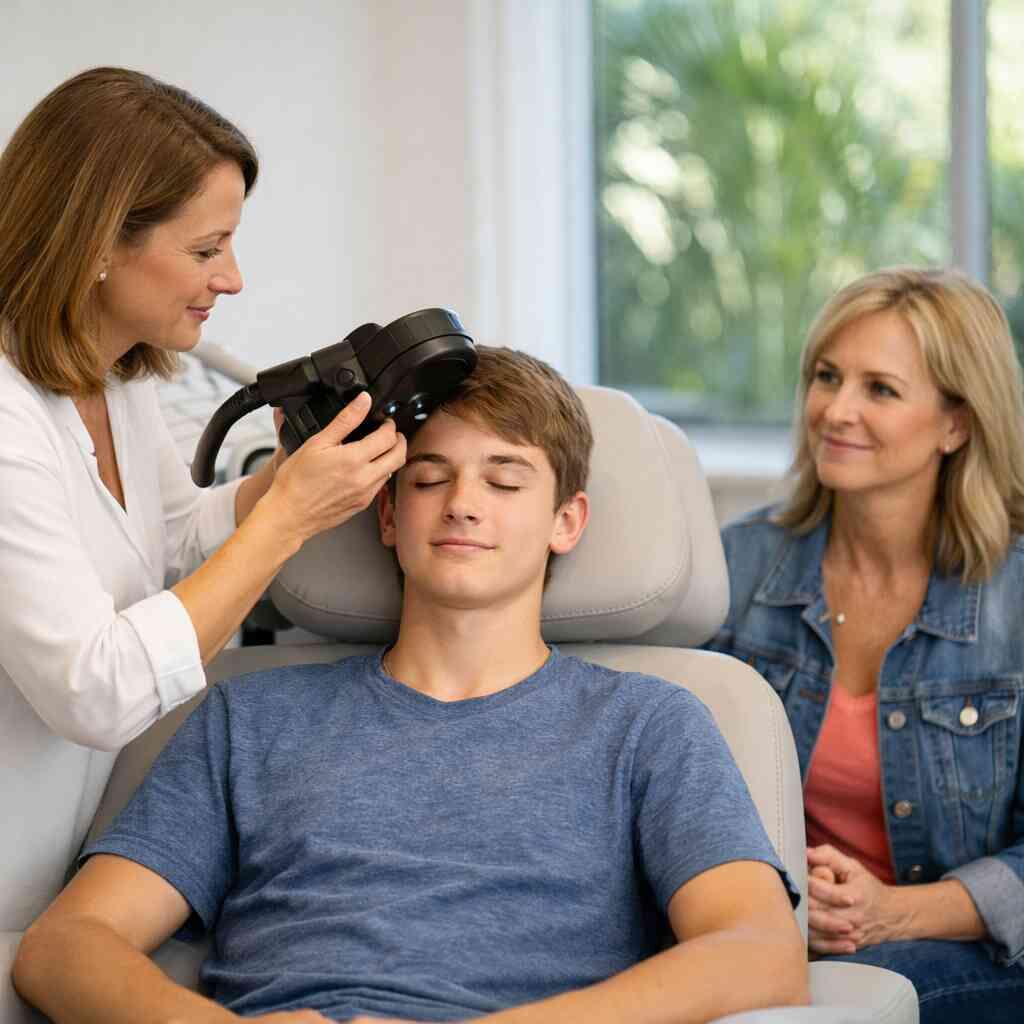
When teen depression keeps winning after therapy and meds
If you are reading this because your teen has already tried one medication after another, that sinking feeling is real. You keep hoping the next prescription will be the one. Then school slips, sleep gets strange, and the whole house starts revolving around symptoms. That is often the moment families begin asking about TMS treatment Florida and teen depression treatment in Orlando.
Why Orlando families start asking about TMS after the fifth or sixth failed medication
We hear this from families more often than people think. The pattern is familiar: a teen starts one SSRI, then another, then a dose change, then therapy, then a mood boost that fades. By the time you reach the fifth or sixth attempt, frustration is heavy. That is often when a doctor may discuss transcranial magnetic stimulation therapy as a non-drug depression treatment for medication-resistant depression.
One parent in the Orlando area described it as “watching my child do everything right and still not get better.” That sentence stays with you. It captures the exhaustion, the guilt, and the hope that feels hard-won. For families comparing options, TMS after failed medications can feel less like another guess and more like a structured next step.
If you want a local starting point, this kind of evaluation often begins at a Florida mental health clinic for personalized TMS treatment planning. The important part is not chasing a label. It is matching care to the teen sitting in front of you.
What teen depression can look like when school, sleep, and screen time all start to fall apart
Teen depression rarely looks neat. A parent may notice morning absences, longer naps, closed bedroom doors, or grades that drop without warning. Some teens stop answering texts. Others stay online for hours and still feel empty. When depression deepens, it can affect appetite, concentration, motivation, and even how a teen speaks.
Here is the part most families miss: screen time is often not the cause. It can become a hiding place. The real issue may be adolescent mental health support that has not matched the level of pain. If you see school avoidance, irritability, or tears that come out of nowhere, those can be signs that a deeper mood disorder treatment plan is needed.
A high school student near Lake Nona once came in after missing nearly half a semester. The family thought it was laziness at first. It was not. Sleep had flipped, anxiety was spiking, and the teen had stopped believing treatment would help. That is exactly the kind of situation where a Florida clinician may start asking whether alternative depression treatment is reasonable.
Why a Florida mental health clinic may suggest non-drug depression treatment instead of another prescription
A thoughtful clinic does not jump to TMS because it sounds modern. It considers the pattern. If a teen has had a poor response, side effects, or repeated relapse, a doctor may discuss non-invasive brain stimulation instead of another medication switch. That choice can feel surprising, but it is grounded in clinical reasoning.
The best-known depression research includes work such as the Stanford-led 2018 study by Carpenter and colleagues, which helped strengthen discussion around TMS for depression. TMS is also an FDA-approved depression treatment for certain indications in adults, and clinicians often use that evidence base to guide careful adolescent conversations. For young people, the decision remains individualized and should be handled by a qualified specialist.
If you want to see how local care is framed, review TMS treatments for depression. It helps to think of TMS as a tool, not a promise. It is one option in a broader, careful plan.
Why TMS treatment Florida feels different from another mental health appointment
The first thing families notice is that TMS does not look like traditional psychiatry. There is no sedation. There is no recovery room. The teen sits awake, and the process feels more like a focused medical procedure than a long, emotional appointment. For many parents, that difference matters because it lowers fear.
How transcranial magnetic stimulation therapy uses magnetic brain therapy without anesthesia or downtime
How does TMS work? In simple terms, it uses brief magnetic pulses to target brain circuits involved in mood regulation. This is why people sometimes call it magnetic brain therapy. The treatment is non-invasive, and teens usually return to school, homework, or sports afterward if the clinician approves.
Most conversations include terms like repetitive TMS and deep TMS therapy. Repetitive TMS uses repeated pulses over a treatment area. Deep TMS reaches broader networks in a different way. Both belong to the larger family of non-invasive brain stimulation and are discussed in the context of transcranial magnetic stimulation research.
If you want a plain-English comparison, the difference between TMS and rTMS for depression in 2026 explains the rhythm of treatment well. Families often feel calmer once they understand the hum, the chair, the coil, and the fact that the teen remains awake. The mystery usually causes more stress than the actual session.
Why repetitive TMS and deep TMS therapy are often discussed for medication-resistant depression
The phrase medication-resistant depression sounds harsh, but it simply means the usual medication path has not worked well enough. That is where TMS depression treatment Florida enters the picture. Clinicians may recommend it after failed medications because it approaches mood symptoms differently than pills do. It does not rely on daily systemic drug exposure.
Research and consensus reviews, including guidance from the Clinical TMS Society and major psychiatric associations, support TMS as an evidence-based option for selected patients. For adults, clinical teams often track change with tools like the MADRS or PHQ-9. Those measures help clinicians watch patterns instead of guessing. For teens, the same logic applies with age-appropriate judgment and close supervision.
Some families ask about deep TMS therapy versus standard protocols. That conversation should be specific, not generic. The right choice depends on symptoms, prior treatment history, and clinical judgment, not marketing language.
What TMS side effects safety and comfort usually mean for teens and parents
Safety questions come up fast, and they should. Parents want to know what their child will feel, what the risks are, and whether school can continue. In most cases, TMS side effects are described as mild and temporary, though that can vary. Common concerns include scalp discomfort, headache, or fatigue.
That is why TMS side effects safety matters so much in the intake visit. A skilled clinician should explain what is known, what is uncertain, and what to watch for. Families also want to know whether the teen can tolerate the sound and the sitting time. Comfort matters. So does trust.
If you want a deeper clinical overview, review TMS treatment Florida guide to side effects and safety. The short version is this: the process is generally designed to be manageable, but it still deserves careful screening. No good clinic should rush that part.
Inside a teen depression treatment plan in Orlando
A good TMS plan starts before the machine ever turns on. The evaluation matters because it sorts out depression from anxiety, bipolar symptoms, trauma, sleep issues, and substance use concerns. That conversation should feel slow enough to be useful. It should not feel rushed or overly scripted.
What the evaluation process looks like before TMS for teen depression begins
Before TMS for teen depression begins, clinicians typically review symptom history, medication trials, therapy history, sleep patterns, and safety concerns. They may also ask about family history, school stress, and medical factors. If a teen has other mood symptoms, the team should screen carefully. That is how personalized planning happens. Florida clinics also have to work within state oversight for outpatient services, including the practical standards enforced through the Florida Agency for Health Care Administration. Families do not always think about that piece, but they should. Good clinic structure matters. So does documentation. If you are comparing local options, a TMS treatment in Orange County page can help you understand access. In our experience, Orlando families want two things: clarity and convenience. They want to know the teen can get there consistently, without turning treatment into another battle. 
How PHQ-9 and other check-ins help measure changes without guessing
Here is what almost no online guide mentions. Families often feel better when progress is measured, not assumed. Tools like the PHQ-9, MADRS, and symptom check-ins give structure to the process. They help the team see whether energy, sleep, concentration, and mood are shifting in the right direction.
That is especially important for teens, whose moods can change fast. One rough afternoon does not define a month. One good week does not mean the problem is gone. Measurement protects you from wishful thinking and from hopeless thinking.
The question is not only, “How does the teen feel today?” It is also, “Is the pattern changing?” That is why evidence-based care matters. It keeps everyone honest.
Where family-centered mental health care fits when school stress, anxiety, and mood symptoms overlap
Teen depression rarely travels alone. Anxiety, irritability, perfectionism, and even obsessive thinking may sit right next to it. That is why family-centered mental health care is not a nice extra. It is part of the treatment design.
A parent from Winter Park once said the hardest part was “not knowing which problem to name first.” That is a common feeling. School stress can deepen depression. Depression can intensify anxiety. If OCD traits or trauma symptoms are present, the plan may need to include more than one treatment path. Sometimes families also ask about TMS and EMDR combination care, especially when trauma is part of the picture.
For support that keeps the family loop included, see best family support tips during TMS treatment Florida care. When parents understand the plan, teens often feel less watched and more supported. That shift can matter a lot.
Why Orlando access matters for families from Winter Park, Lake Nona, and nearby Central Florida communities
Access shapes follow-through. If a clinic is too far, too complicated, or too inconsistent, families stop. That is why TMS Orlando and nearby Central Florida access matter so much. A practical schedule can be the difference between staying engaged and dropping out.
Orlando families often think in terms of traffic, school pickup, and work hours. That is real life. Families from Winter Park, Lake Nona, and surrounding communities need care that fits daily routines. The same is true for families commuting from Aventura, Coral Gables, Boca Raton, or Delray Beach who compare options across South Florida and Central Florida.
If you are comparing coverage across the state, you may also search for TMS clinic Miami, TMS Fort Lauderdale, TMS West Palm Beach, TMS Tampa, or TMS near me Florida. That search pattern makes sense. Families want the closest reliable option, not a theoretical one.
What helps Florida families decide if TMS is the right next move
By this stage, most parents want a straight answer. Should we keep changing meds, intensify therapy, or consider TMS? The honest answer is that the right path depends on the teen’s history, safety needs, and current level of impairment. No online article can decide that for you. A qualified clinician can help sort it out.
How TMS depression treatment Florida compares with medication changes, therapy, and higher levels of care
Compared with another medication switch, TMS offers a different mechanism. Compared with therapy, it is more biologically targeted. Compared with a higher level of care, it may fit teens who need something more active than weekly counseling but less disruptive than inpatient treatment.
OptionWhat it usually involvesMain tradeoffMedication changesNew drug, new dose, more waitingSide effects and uncertain responseWeekly therapyTalk-based support and coping skillsMay be too light for severe symptomsTMSRepeated in-office brain stimulation sessionsRequires regular attendanceHigher level of careIntensive outpatient or partial hospitalizationMore time, more disruptionFor many families, this comparison clarifies the question. TMS depression treatment Florida is not a replacement for all other care. It is one evidence-based option within the larger Florida behavioral health landscape.
What TMS insurance coverage Florida and TMS cost Florida questions usually involve for parents
Money questions are practical, and they should be answered directly. TMS cost Florida depends on diagnosis, insurance, clinic policies, and authorization requirements. That means there is no honest one-size-fits-all number. Does insurance cover TMS in Florida? Sometimes yes, but the details matter.
Parents usually need to confirm prior authorization, diagnosis criteria, prior treatment history, and plan-specific rules. This is common in Florida because insurance networks can vary widely. Families also ask about TMS insurance coverage Florida when they are comparing clinics. That is smart.
For a closer look at common financial questions, see TMS cost in Florida and insurance coverage questions. If you want to compare Florida plans carefully, top 5 TMS insurance coverage tips for Florida families 2026 can help. The goal is simple: no surprises at the desk.
When TMS for anxiety, TMS OCD therapy, or TMS for bipolar depression may also enter the conversation
Teen depression often overlaps with anxiety. Sometimes obsessive thoughts are part of the picture. Sometimes mood swings raise concern about bipolar depression. That is why TMS for anxiety, TMS OCD therapy, and TMS for bipolar depression may come up in the same consultation.
Research is still growing in these areas. The evidence is strongest for depression, while other uses remain more condition-specific and should be reviewed carefully. Families should also ask about TMS for PTSD Florida if trauma symptoms are prominent, or about TMS addiction recovery and TMS for substance use disorder if cravings and depression travel together. Some programs discuss alcohol addiction brain stimulation and TMS for smoking cessation within that broader research conversation, often alongside dual diagnosis treatment Florida and addiction rehab Florida.
If your teen has multiple symptoms, do not let the label narrow the conversation too early. Look for a clinic that can explain the fit with nuance.
Why the next conversation should be with a TMS psychiatrist Florida who can match care to the teen, not the label
The most useful next conversation is with a clinician who understands both adolescence and TMS. A TMS psychiatrist Florida should review the full picture, not just one diagnosis code. That includes school functioning, medication history, family stress, sleep, substance exposure, and safety planning.
If you are comparing providers, look for transparent communication, careful screening, and clear follow-up. A good clinic should be able to explain TMS therapy success rate honestly without overselling. It should also discuss TMS long-term results and TMS maintenance therapy as possibilities, not guarantees. Some families read TMS reviews Florida before deciding, and that can be helpful when used wisely.
If you are ready to compare options, start with a best TMS clinic Florida search that values fit over hype. You do not have to solve everything tonight. Start with one call, one insurance question, and one clear evaluation request.
Frequently Asked Questions
Question: How does TMS treatment Florida help teens in Orlando who have tried therapy and medications without enough relief?
Answer: TMS treatment Florida offers transcranial magnetic stimulation therapy as a non-invasive brain stimulation option that may be considered when a teen has medication-resistant depression or has not improved enough with standard care. Instead of adding another daily medication, TMS uses magnetic brain therapy in a clinic setting, which can be helpful for families looking for an alternative depression treatment after failed medications. A qualified TMS psychiatrist Florida should review the teen’s full history, including mood symptoms, school functioning, sleep, anxiety, and any other concerns, before recommending a plan. This careful evaluation is important because the goal is not to guess, but to match the treatment to the teen’s needs.
Question: What should families know about How TMS Treatment Florida Helps Teen Depression in Orlando before starting care?
Answer: The first step is usually a detailed evaluation to understand whether TMS for teen depression is a good fit. In Orlando, families often want a Florida mental health clinic that can explain how does TMS work, what repetitive TMS or deep TMS therapy may involve, and what the visit schedule looks like. A good clinic should also discuss TMS side effects safety clearly, including common temporary concerns like scalp discomfort or headache, and should be honest that every case is different. This kind of compassionate depression care helps parents feel informed and helps teens feel less overwhelmed by the process. It also allows the team to decide whether TMS for young adults, family-centered mental health care, or another level of support makes the most sense.
Question: Is TMS depression treatment Florida only for depression, or can it also help with anxiety, OCD, or other conditions?
Answer: While TMS depression treatment Florida is best known as an FDA-approved depression treatment for certain indications in adults, many families also ask about related concerns such as TMS for anxiety, TMS OCD therapy, TMS for PTSD Florida, or TMS for bipolar depression. In some situations, a clinic may also discuss TMS addiction recovery, TMS for substance use disorder, or dual diagnosis treatment Florida when mood symptoms overlap with substance use concerns. The key is individualized evaluation. A responsible provider should not promise the same result for every diagnosis, but should explain what the evidence supports, where research is still growing, and whether TMS and EMDR combination care or another plan may be more appropriate.
Question: What about TMS cost Florida and does insurance cover TMS in Florida for teen depression treatment?
Answer: TMS cost Florida can vary based on the clinic, the diagnosis, insurance requirements, and whether prior authorization is needed. Families commonly ask does insurance cover TMS in Florida because coverage rules can differ by plan. A trustworthy clinic should help you understand TMS insurance coverage Florida without making unrealistic promises or giving exact pricing before reviewing the case. It is also reasonable to ask about paperwork, session frequency, and what documentation may be needed to support approval. This kind of clear guidance helps families compare options like TMS Orlando, TMS Tampa, TMS Fort Lauderdale, or TMS South Florida while focusing on fit, access, and long-term planning rather than surprise costs.
Question: How do Orlando families decide whether TMS is the best next step compared with other mental health support?
Answer: Families often decide by looking at the teen’s full treatment history and current level of impairment. If weekly therapy alone is not enough, if medication changes have not worked, or if depression is affecting school, sleep, motivation, or relationships, then TMS after failed medications may be worth discussing. A qualified TMS psychiatrist Florida can help compare TMS therapy success rate evidence, TMS maintenance therapy options, and TMS long-term results research without overpromising outcomes. The right choice may also depend on whether the teen needs a more intensive setting such as addiction rehab Florida, broader Florida behavioral health services, or simply a local best TMS clinic Florida that is convenient to reach. If you are searching for TMS near me Florida, the most important thing is finding a clinic that offers personalized treatment planning, honest expectations, and supportive follow-up.
Question: Why do families searching for TMS reviews Florida want an Orlando-based clinic for teen depression care?
Answer: Many families want a local clinic because consistency matters. Teens are more likely to continue treatment when the schedule fits school, transportation, and family routines. That is why searches for TMS Orlando, TMS near me Florida, or even nearby locations like TMS clinic Miami, TMS Fort Lauderdale, TMS West Palm Beach, and TMS Tampa are so common. Reviews can be helpful when they focus on communication, scheduling, and professionalism rather than dramatic claims. A strong clinic should explain the process clearly, support families with compassionate depression care, and make room for questions about TMS cost Florida, TMS side effects safety, and whether the teen may benefit from non-drug depression treatment. In other words, the best fit is usually the clinic that feels medically thoughtful, transparent, and genuinely supportive.


